
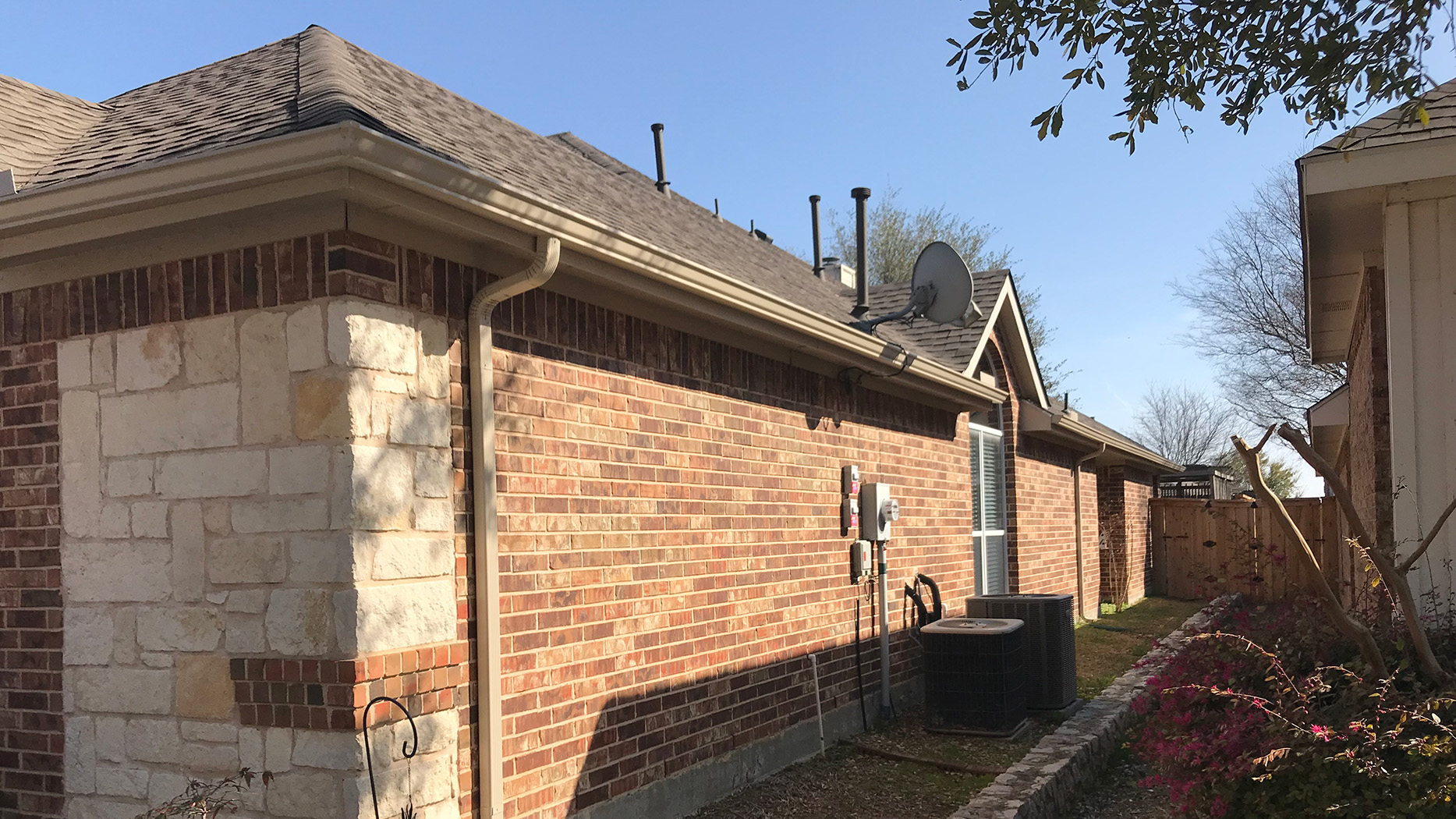
When rain spills over your gutters, organize your inspection request around three questions: Is the drainage path clear? Is the system sized for the water it receives? Are the outlets positioned appropriately? For your North Texas home, request photographs, measurements and an explanation connecting each proposed change to an observed condition. Use the questions below to make that conversation specific before choosing a repair.
Start with a record of where water escapes
From a sheltered indoor location, record what you can see without stepping into the rain. Mark the affected side of the house on a simple sketch. Note whether you observed one spill point or several, and whether the problem appeared throughout the rain or only during its heaviest period. Share those observations without assigning a cause.
Ask: “Can you identify the exact location where water leaves the intended drainage path?” Request photographs labeled to match your sketch. This gives you a common reference when discussing the estimate, especially if several corners look alike. Leave elevated inspection and testing to the professional; focus your own documentation on what is visible from indoors or safely from the ground after the rain.
Ask for evidence before accepting a blockage diagnosis
University of Minnesota Extension’s shoreland-property runoff guide recommends keeping gutters clear of debris and draining properly. Use that maintenance guidance to prepare an inspection question for your North Texas home: “What debris did you find, where was it, and can you show me before-and-after photographs?” The purpose is to request evidence for the diagnosis rather than accept an assumption based on the overflow complaint.
- Was the gutter channel inspected along the entire affected run?
- Was the opening into the downspout checked, along with the downspout itself?
- If the downspout connects to another drain, where did the inspection stop?
- After clearing any debris, what verification will be included?
Ask for inspected components and inaccessible areas to be listed separately. If the proposed scope is cleaning, request a description of what that includes. If additional work is recommended, ask which findings support it and whether the recommendation should be reassessed after cleaning. Keep the original photographs with the follow-up findings so you can review both together.
Evaluate gutter size and downspout capacity together
PNNL’s Building America Solution Center recommends sizing gutters and downspouts for anticipated water loads. Its discussion of larger gutters pairs increased water conveyance with sufficient downspouts to drain the channels. Ask the estimator to explain how adequate downspout capacity will support the intended benefit of a larger gutter across the proposed system.
Ask: “Which roof areas feed this run, and what measurements support the proposed gutter and downspout sizes?” Request a sketch identifying the contributing roof areas, existing gutter dimensions and existing downspout dimensions. The purpose is to make the recommendation reviewable instead of relying on a general statement that your gutters are too small.
Follow with: “What rainfall assumptions did you use, and which components would change under this proposal?” Ask the estimator to explain the existing arrangement and the proposed arrangement using the same sketch. If several options are offered, request the reasoning for each, including why an option was recommended for your particular overflow complaint.
Clarify which outlet location needs attention
Ask whether the proposed outlet work concerns the opening from the gutter into a downspout or the place where water exits near the ground. Request labels for both on the sketch. This gives you a way to check whether an estimate for relocating a downspout also explains its final discharge point.
PNNL explains that closer downspout spacing increases the amount of water that can be carried away during peak rainstorms. Ask: “Would changing the number or position of downspouts be appropriate here, and what findings support that choice?” Request the existing and proposed locations, along with the reasoning for keeping or changing each one.
Also ask: “Were the gutter’s slope and drainage direction measured, and can those findings be included?” PNNL describes gutter slope as a means of directing water toward downspouts. Request the measurements to bring the existing drainage arrangement into the discussion before selecting a modification. Ask the contractor to mark any area that could not be evaluated.
Follow the drainage route to its endpoint
PNNL advises directing surface discharge onto sloped ground that carries water away from the building without allowing it to return. Ask: “Where will water go after it leaves this downspout, and can you show that route on the plan?” Request an explanation that continues beyond the visible gutter work to an identified destination.
- Does the proposal include the final discharge point or only the downspout?
- If an underground connection exists, was its destination verified?
- Are any drainage components outside the proposed inspection or repair scope?
- Will the proposed route cross a walkway, planting bed or frequently used yard area?
University of Minnesota Extension’s shoreland-property guide also recommends erosion protection where gutter outlets discharge onto soil. Ask whether that consideration applies at your proposed endpoint and how it will be evaluated. If an underground connection’s destination is unknown, request that the uncertainty be written into the estimate, along with any proposed next step for investigating it.
Compare estimates by findings and completion checks
Ask each contractor to organize the estimate around the same information: observed condition, supporting photographs or measurements, proposed work and completion checks. Use that structure to compare proposals even when recommendations differ. Request quantities and locations, and ask for clarification of broad descriptions such as “improve drainage.”
Ask: “What will you check after the work, and what would require another evaluation?” Request a defined verification method and a record of the result. If the scope includes several changes, ask for the purpose of each. Keep unresolved questions visible and request a written explanation of any limits to the inspection before deciding what work to authorize.
Bring a focused inspection request to Longhorn
Review Longhorn’s gutter and fascia services, then use the website inquiry form to describe the affected side of your home, observed spill points and previous work. Request findings addressing blockage, sizing, outlet placement and the final discharge route. Include your sketch and ask which additional information would help evaluate the complaint.
For the research behind these questions, see PNNL’s gutters and downspouts guide and University of Minnesota Extension’s shoreland-property runoff guide. Use these resources to prepare for a property-specific inspection and request an explanation of how the proposed scope addresses your observations.