
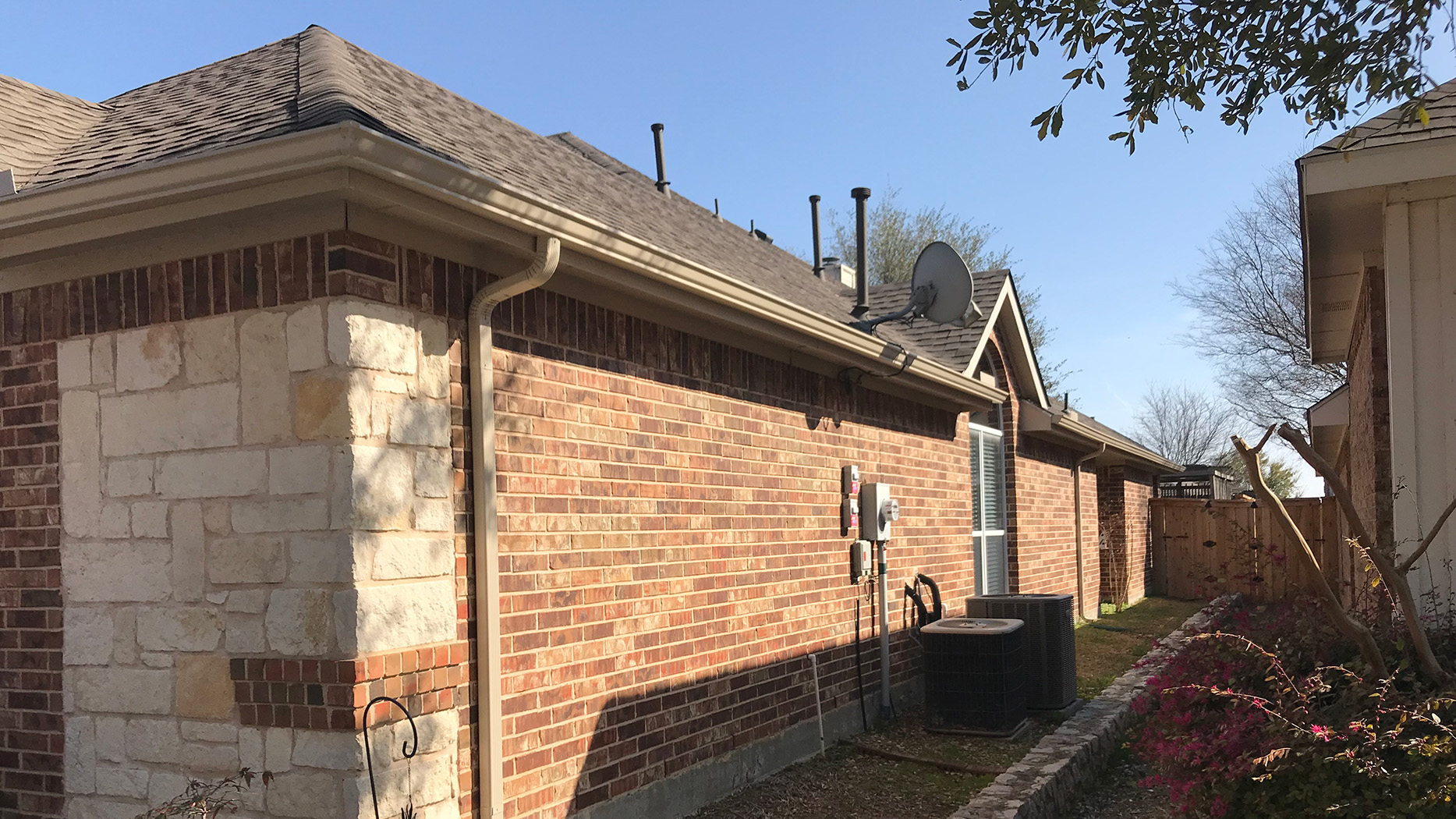
For many full gutter replacements, a properly designed seamless system is a practical choice: it avoids repeated connections along straight runs and can follow the measured roof edge neatly. Sectional gutters can still be useful for a limited repair or a smaller project. Neither label guarantees good drainage, and a sound existing sectional system does not automatically need replacement.
For a Texas homeowner comparing estimates, the most useful question is: what will this complete system do with the water arriving from my roof? Start with the difference in construction, then look beyond it.
What is the difference?
Sectional gutters use shorter pieces joined together to make a run. Their connections need the appropriate assembly and sealing for the product. Seamless gutters are formed in continuous lengths for straight runs, commonly from metal coil using a gutter machine. Corners, end caps and outlets still create connections in the overall system.
Englert's seamless gutter catalog shows continuous-run components alongside miters, outlets, end caps and sealants. That distinction matters: seamless describes the run, not a system without any joints.
| Question | Seamless | Sectional |
|---|---|---|
| Straight-run connections | Fewer intermediate joints | Connections between lengths |
| Installation | Measured and formed for the run | Assembled from compatible sections |
| Small repairs | May need a replacement run or compatible detail | A matching section may be practical |
| Maintenance | Clean and inspect outlets, corners and attachments | The same checks, plus intermediate joints |
| Leak-proof? | No | No |
The drainage design matters more than the label
A long straight run and a short run below a concentrated roof valley do not receive water in the same way. Roof area and geometry, gutter profile, downspout capacity and the route away from the building belong in the assessment. Overflow can be a blockage, a layout problem or a capacity problem; simply buying a larger gutter does not identify the cause.
The Building America Solution Center guidance on gutters and downspouts treats them as part of water management around the building. Water needs a suitable discharge route after leaving the downspout. A neatly installed gutter that dumps water into a troublesome area beside the house is an incomplete solution.
Longhorn's gutter and fascia service considers collection, gutters, downspouts and discharge together. Available standard options include 5-inch and 6-inch seamless gutters, primarily K-style, with the selection based on the property. The larger option is not a universal upgrade.
Why seamless gutters can still leak or overflow
A seamless run still meets an end cap, an outlet or a corner. Those details can require attention. Leaves or sediment can restrict water flow, and a poorly positioned or inadequately supported run can perform badly regardless of how many seams it has. "Seamless" should never be treated as a promise of zero leaks or zero maintenance.
Ask the installer where the joints will be, how each connection will be handled and how the attachment matches the fascia and roof edge. Manufacturer details are material-specific: for example, Berger's product catalog describes connection methods for its different gutter products. A method for one material should not be assumed to apply to every system.
Repair a section or replace the system?
A localized damaged area is a different project from recurring leaks at multiple joints. Before replacing everything, ask whether the rest of the system is sound, whether compatible parts are available, and whether the original layout works. A repair that keeps a defective discharge arrangement is not the same value as correcting the cause.
Conversely, a full seamless replacement can make sense when several runs need work and the layout can be improved at the same time. Ask for the reason in writing. Fascia should be evaluated, but sound fascia does not need to be replaced merely because new gutters are being installed.
Compare complete estimates, not a single price per foot
- Measured scope: run lengths, corners, end caps and removal of old materials.
- Material: metal type, thickness, finish, profile and color.
- Attachment: proposed hanger system and any actual fascia repairs.
- Downspouts: quantity, dimensions, outlet locations, elbows and discharge treatment.
- Access: height, obstacles and any special access requirements.
- Aftercare: what is covered by the written warranty and what maintenance remains yours.
Do not compare a materials-only sectional purchase with an installed seamless quote as though they cover the same work. Likewise, the lowest installation price may omit removal, fascia work or a necessary downspout. Ask each bidder to price the same scope before deciding.
Plan for maintenance with either choice
Watch for overflow from a safe location during rain, then describe where it happened. Arrange safe cleaning and inspections as needed, particularly where nearby trees contribute debris. Gutter guards can change maintenance needs, but they are not a blanket exemption from inspection; Berger notes that guard performance depends on product selection and installation conditions.
If roofing work is also planned, coordinate the roof-edge work and gutter scope so their details are compatible. To compare options for your property, request a Longhorn gutter estimate. Tell us which areas overflow, whether you want a repair or replacement assessment, and where the downspouts currently discharge.